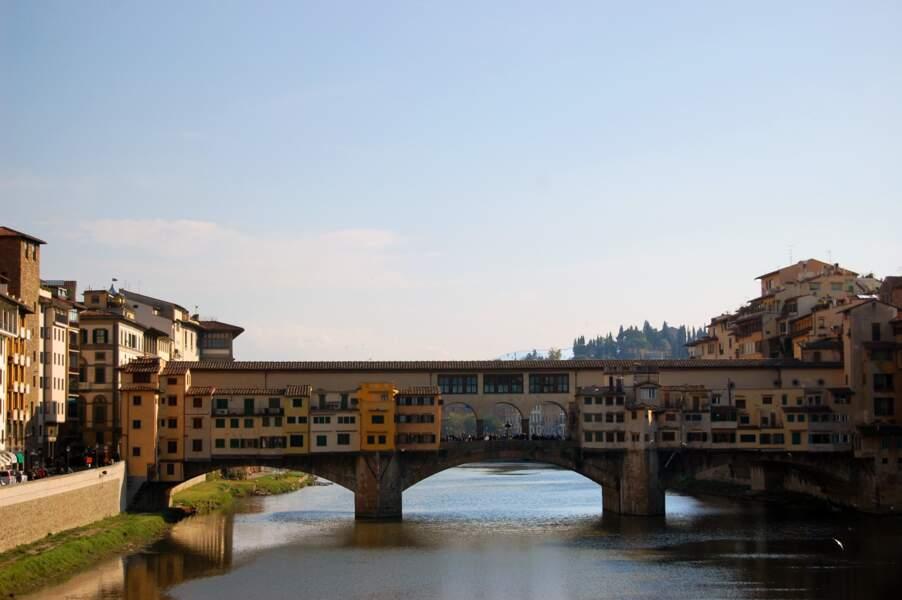
 The Ponte Vecchio
Florence's oldest and most famous bridge: the Ponte Vecchio, built of wood in Roman times, was destroyed by an exceptional flood of the Arno in 1333. It was only twelve years later that Taddeo Gaddi and Neri di Fioravante decided to rebuild it in stone.
Today, the Ponte Vecchio is both a pedestrian thoroughfare and a shopping arcade, where jewellers and goldsmiths bustle about in place of the butchers and trimmers who livened the place up centuries ago.

The Duomo in Florence
The Cathedral of Santa Maria del Fiore, also known as the Duomo, stands out from the rest of the Florentine landscape. Not content with being Florence's main church, it was built in the late 13th century and is one of the largest churches in Europe. Its gigantic dome, designed by the architect Filippo Brunelleschi in 1436, is one of the features that led to its inclusion on UNESCO's World Heritage List in 1982. For a breathtaking view of the surrounding area, you'll need to climb some 400 steps. Panoramic views guaranteed!

The Bargello Palace
Despite its austere appearance, the Bargello, or Bargello Palace, is well worth a visit in Florence. Built in the middle of the 13th century, it was for a long time the headquarters of the Florentine police before being turned into a prison. Since 1865, it has housed a national museum, the Museo Nazionale del Bargello. It features a portrait of Dante by the Florentine artist Giotto di Bondone.

Palazzo Vecchio
In the Piazza della Signoria, this palace-fortress, built mainly in the 14th century, was intended to demonstrate the full power of the Florentine government at the time.
Designed by the architect Arnolfo di Cambio, it features a belfry tower, the Torre di Arnolfo, a series of coats of arms painted on the main façade of the building, and three main courtyards.

The Boboli garden
At the top of the hill, the Boboli Garden, one of Florence's historic parks, is one of the most beautiful in Europe. Conceived and designed for Eleonora of Toledo, the garden behind the Pitti Palace covers more than 45,000 m2. It offers both exceptional green landscapes and a collection of Roman and Florentine sculptures, which almost a million visitors from all over the world come to admire every year.

The Uffizi Gallery
Whether you're a painting enthusiast or not, don't miss a visit to the Uffizi Gallery, housed since 1765 in the Florentine palace designed by Giorgio Vasari. Here you can admire works by artists such as Leonardo da Vinci, Titian, Botticelli and Piero della Francesca.

Piazza della Signoria
Together with the Piazza del Duomo, the Piazza della Signoria is one of the most popular squares in the Tuscan capital. In the centre of the city, you'll discover a veritable open-air museum, with ornamental statues and facades built in the Renaissance style. From here you can walk straight to Palazzo Vecchio, the Uffizi Gallery and the famous Ponte Vecchio.

La loggia del Pesce
The Loggia del Pesce owes its origins to Cosimo I, who had it built in the second half of the 16th century by the Florentine architect Giorgio Vasari. Dismantled at the end of the 19th century, the Loggia del Pesce was rebuilt in 1956 using the original materials. The original architecture, including nine arcades, was faithfully reproduced. Now located in the Piazza dei Ciompi, it was once used as a retreat by fishmongers who had been chased out of the Ponte Vecchio.

The fortress of Basso
Once a place of refuge for Florentine rulers in the event of popular revolt, the Basso Fortress now hosts events such as congresses and fashion shows. A masterpiece of Florence's military heritage, it was designed by the architects Pier Francesco da Viterbo and Antonio da Sangallo the Younger, and built between 1534 and 1537.

Villa Medicea di Castello
Among the many Medicean villas, take a look at this one, which is well worth a visit for its magnificent Italian-style garden, free of charge. You can also admire the sublime façade of this 14th-century Florentine villa, which once housed Botticelli's painting"The Birth of Venus". After several alterations and renovations, it is now closed to the public, as it houses an academy of Italian scholars comparable to the Académie française.
See also